
SmartScout’s AI tools do more than save time on writing Amazon listings. They also tell you whether Amazon’s AI shopping assistant, Rufus, is actually recommending your products. The platform offers three dedicated AI tools in 2026: a listing generator, a Cosmo-aligned scorecard, and an AI visibility tracker.
This guide walks through every SmartScout AI tool, what it does, and which pricing plan you need to use it.
Key Takeaways
- SmartScout offers 3 AI tools: AI Listing Architect, Amazon AI Scorecard, and AI Visibility Monitor.
- The Scorecard and Visibility Monitor are Rufus-era tools that no other Amazon platform offers yet.
- All three AI tools unlock on the Essentials plan at $97/month.
What AI Tools Does SmartScout Offer in 2026?
SmartScout offers three AI tools that cover the full AI listing workflow: writing a listing, grading it against Amazon’s Cosmo knowledge graph, and tracking whether Rufus actually surfaces it in shopper recommendations.
Here are all three:
- AI Listing Architect – generates titles, bullets, descriptions, and backend search terms.
- Amazon AI Scorecard – grades listings against Amazon’s Cosmo knowledge graph with a letter grade and 15-point breakdown.
- AI Visibility Monitor – tracks whether Rufus and ChatGPT surface your products in AI recommendations.
Listing creation used to be the whole AI story, but with Amazon pushing shoppers into Rufus conversations before they hit the search bar, visibility tracking is quickly becoming just as important.
AI Listing Architect
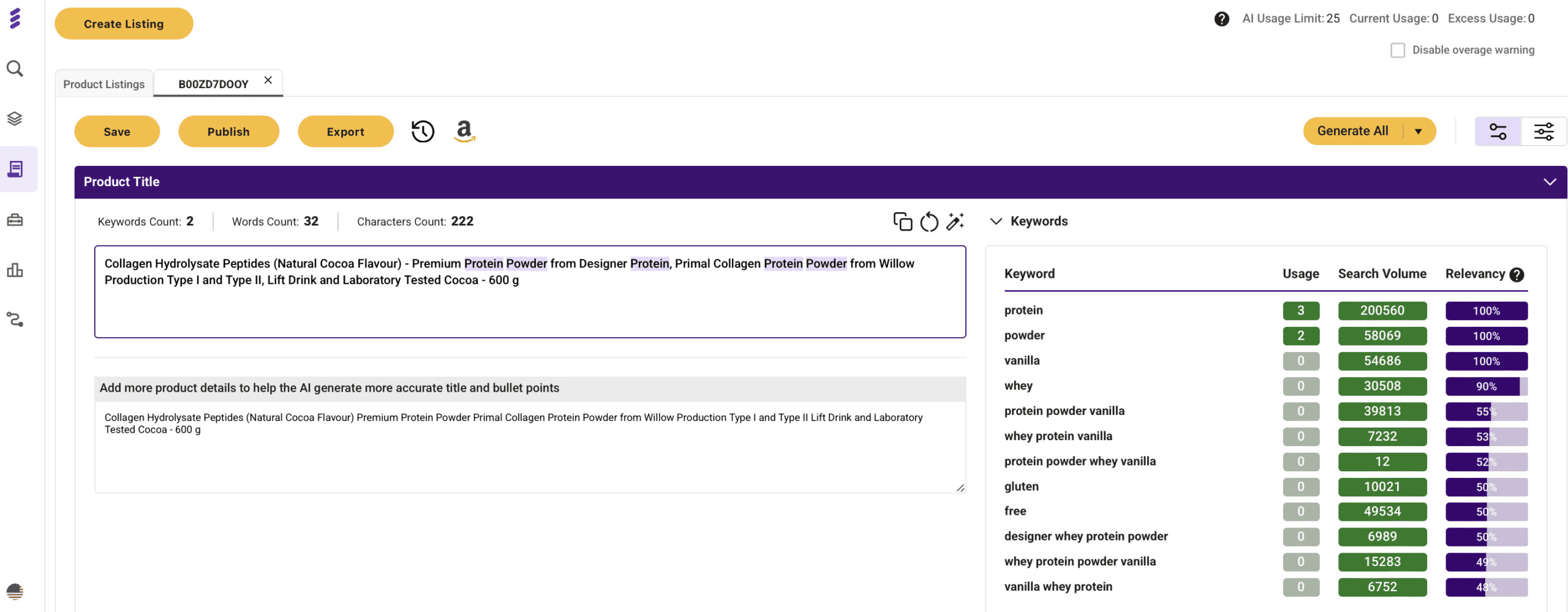
The AI Listing Architect is SmartScout’s flagship AI feature. You feed it a short product input (details, a seed keyword, or an existing ASIN) and it generates a full Amazon-ready listing in a few minutes.
The output includes a keyword-front-loaded title, five benefit-led bullet points, a long-form description, and backend search terms most sellers forget to populate properly.
What sets it apart from pasting your product into ChatGPT? The keyword grounding. The Architect pulls its suggested terms from SmartScout’s database of 1.5 million brands and 43,000+ Amazon subcategories, so every listing targets keywords competitors are already ranking for rather than generic phrases ChatGPT guesses from training data.
The catch? The Architect can’t review itself. Brand voice, category compliance (supplements, children’s products, electronics), and A+ content copy are still your job. Plan on a ten-minute human pass after every generation and you’ll still save several hours per listing compared to writing from scratch.
Amazon AI Scorecard
The Amazon AI Scorecard is SmartScout’s newest diagnostic tool, built specifically to grade how well your listing aligns with Amazon’s Cosmo knowledge graph, the AI model that powers Rufus and semantic search. It assigns each listing a letter grade from A to F, plus a 15-point quantitative breakdown of titles, bullets, descriptions, and images.
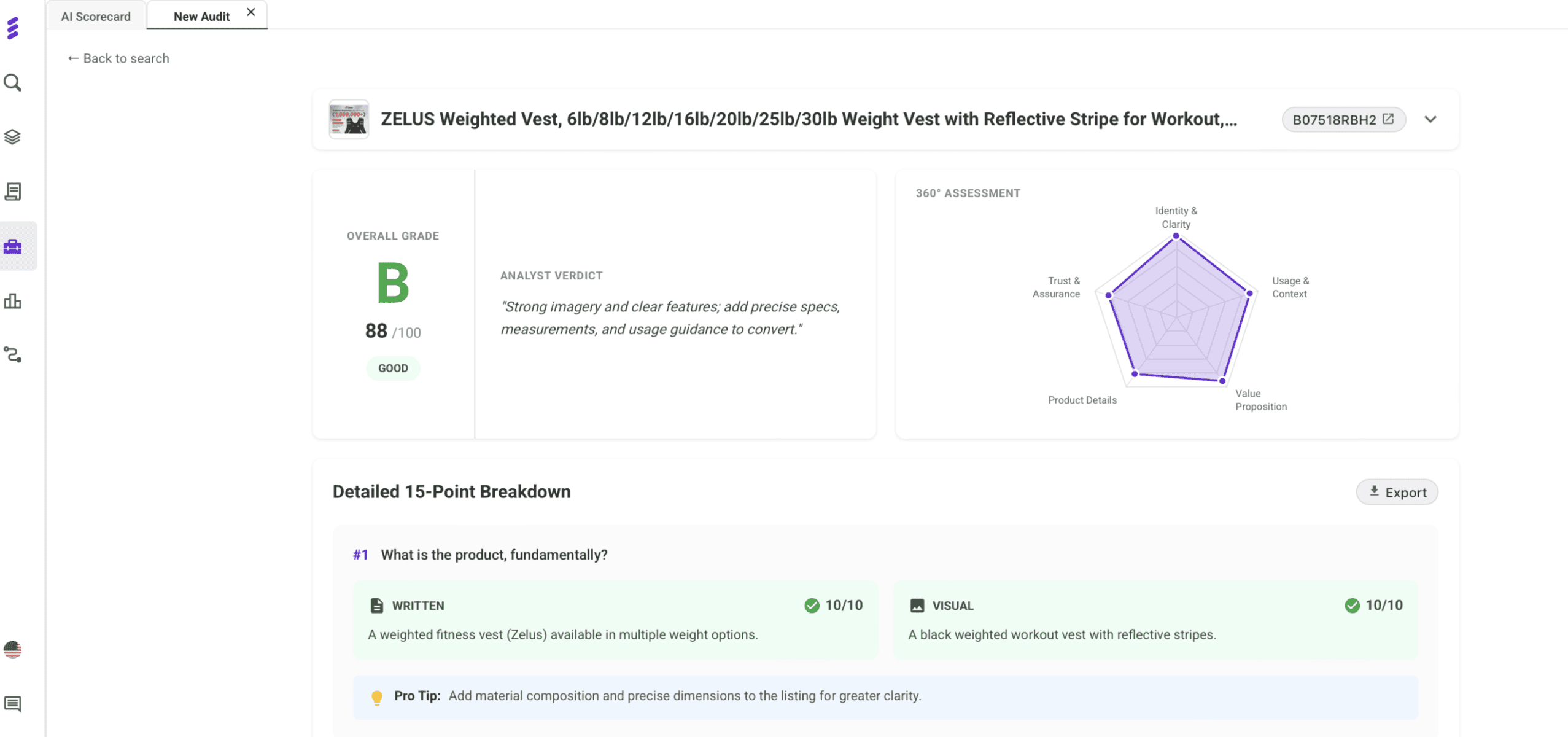
Where the Listing Architect writes the listing, the Scorecard tells you whether the listing you already have is readable to Amazon’s AI. Its 5-point radar chart groups metrics into five clusters: Identity and Clarity, Usage and Context, Value Proposition, Product Details, and Trust and Assurance. Each point comes with a pro tip for fixing the specific gap the scorecard found.
This is the tool most established sellers underestimate. You may already have listings that rank fine in traditional Amazon search but come back as a “C” on the Scorecard because they never populated the knowledge vectors Rufus looks for. Fixing that is a quiet way to rank in AI-shopper conversations your competitors haven’t thought about yet.
AI Visibility Monitor
The AI Visibility Monitor closes the loop on the other two tools. It tracks whether your products actually show up in AI-driven recommendations, across both Amazon’s own Rufus assistant and off-Amazon AI shoppers like ChatGPT. Instead of guessing whether a listing change helped, you can watch your AI visibility ranking move up or down over time.
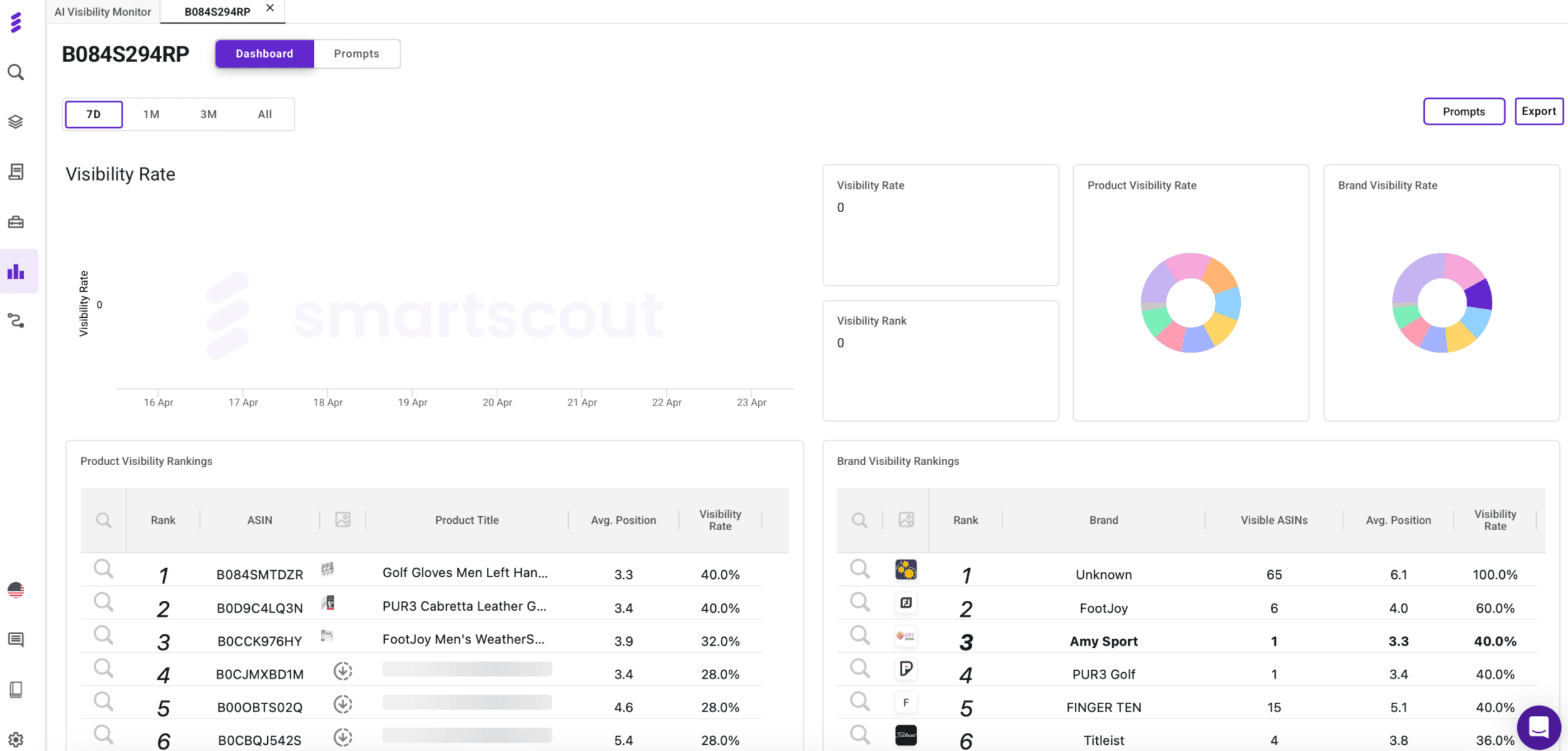
The problem it solves is real and new. Shoppers increasingly ask AI assistants what to buy before they ever visit Amazon.com. If your product isn’t surfaced during those conversations, you’re invisible during the moment that matters. Traditional keyword rankings tell you nothing about this. The Visibility Monitor is the first third-party tool to track it as a measurable metric.
Which SmartScout Pricing Plans Include AI Features?
SmartScout offers four pricing plans, and which AI tools you can use depends on the tier. All three AI tools – AI Listing Architect, Amazon AI Scorecard, and AI Visibility Monitor – unlock on the Essentials plan ($97/month) and above. The Basic plan at $29/month includes SmartScout’s data and research tools but not the AI features.
| Plan | Monthly | Annual (effective) | AI Tools | Best for |
|---|---|---|---|---|
| Basic | $29/mo | $25/mo | Not included | Arbitrage sellers on a budget |
| Essentials | $97/mo | $75/mo | All 3 included | Private-label sellers and wholesalers |
| Business | $187/mo | $158/mo | All 3 + higher limits | Agencies and multi-ASIN brands |
| Enterprise | Custom | Custom | All 3 + team seats | Large brands and aggregators |
Every paid plan is backed by a 7-day money-back guarantee, so you can test the AI tools risk-free and cancel for a full refund if they don’t deliver. For most sellers generating more than a couple of listings a month, Essentials pays for itself in saved hours alone.
How Does SmartScout AI Compare to Helium 10 and Jungle Scout?
SmartScout, Helium 10, and Jungle Scout are the three most popular research platforms in the Amazon seller world, and all three have leaned hard into AI over the last year. Each one approaches it differently, though.
SmartScout made the boldest Rufus-era bet with the Amazon AI Scorecard and AI Visibility Monitor, two tools neither Helium 10 nor Jungle Scout currently offers.
Helium 10 still wins on breadth, bundling PPC AI, inventory forecasting, and review intelligence into a single suite.
Jungle Scout’s AI Assist is the friendliest of the three for sellers just getting started.
Frequently Asked Questions
Does Amazon Allow AI-Generated Product Listings?
Yes. Amazon’s content policies treat AI-generated text the same as human-written text. Origin is irrelevant as long as the listing follows category rules. Over 900,000 Amazon sellers now use generative AI for listings without penalty.
Is SmartScout AI Worth It in 2026?
SmartScout’s AI stack has gotten broader in a way that matters. The AI Listing Architect still solves the single highest-leverage task for most sellers, but the Amazon AI Scorecard and AI Visibility Monitor are the tools that will separate winners from losers as Rufus eats more of Amazon’s shopper traffic. Grading your listings against Cosmo and tracking whether Rufus actually recommends you are jobs nobody else in the Amazon tools space does yet.
Essentials at $97/month is the cheapest way in, and every paid plan comes with a 7-day refund window to test the full AI suite on your own products first.
Get up to 25% off SmartScout and put the AI Listing Architect, Scorecard, and Visibility Monitor to work on your next listing.


