


The short version
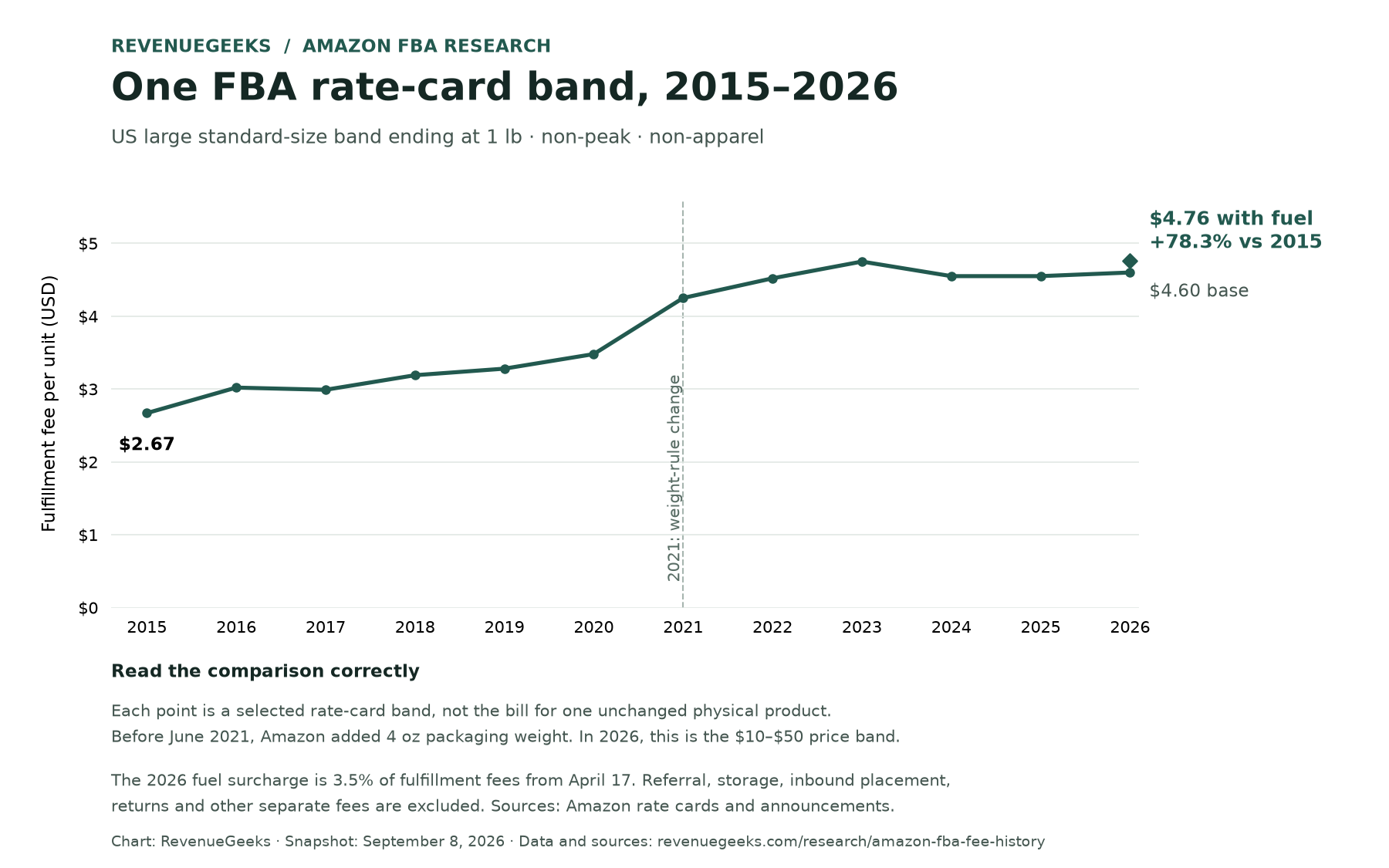
The selected US FBA rate-card band rose from $2.67 in 2015 to $4.60 in 2026, or $4.76 including the April 2026 fuel surcharge. That is a 78.3% increase including fuel. Weight rules and band boundaries changed over time, so this is a rate-card comparison, not the price history of one unchanged physical product.
+78.3%
Fulfillment fee growth 2015 to 2026, with the fuel surcharge
+41.4%
US inflation over the same window (CPI-U to May 2026)
+22.1%
Biggest single step, the June 2021 rate card
7
New fee types introduced since 2022
- Base fulfillment fee for the reference band: $2.67 in 2015 to $4.60 in 2026, up 72.3%.
- 2026 fee including fuel: $4.60 × 1.035 = $4.761, rounded to $4.76. This excludes referral, storage and other separately charged fees.
- CPI-U comparison: +41.4% from the 2015 annual average to the May 2026 monthly reading; not two full-year averages.
- Off-peak storage: $0.54 per cubic foot per month in 2016 to $0.78 on the 2026 schedule.
- The June 2021 change removed the 4 oz packaging-weight adjustment, which affects comparability.
The reference fee, year by year
The table follows the large standard-size band ending at one pound on each selected US non-peak, non-apparel rate card. It shows the chosen base rate and the change from the previous row. It does not average all rates billed during a calendar year or represent every seller’s fulfillment costs.
Year | Fee (1 lb band) | Change |
|---|---|---|
2015 | $2.67 | baseline (Feb 18 card) |
2016 | $3.02 | +13.1% |
2017 | $2.99 | -1.0% (fee structure merged) |
2018 | $3.19 | +6.7% |
2019 | $3.28 | +2.8% (new 10 oz bands) |
2020 | $3.48 | +6.1% |
2021 | $4.25 | +22.1% (June 1, bands redrawn) |
2022 | $4.52 | +6.4%, then a 5% surcharge from Apr 28 |
2023 | $4.75 | +5.1% (surcharge folded into base) |
2024 | $4.55 | -4.2% (paired with new inbound fee) |
2025 | $4.55 | frozen |
2026 | $4.60 ($4.76 with surcharge) | +1.1% base, +4.6% all-in |
The series tracks each card’s published band fee, not one physical product’s bill. Until June 2021 Amazon added roughly 4 oz of packaging weight before picking a band, so a product weighing a full pound on the scale often billed one band higher. Sources include Amazon’s fee pages, archived rate cards and reproductions where the original requires a seller login. See the source list and dated CSV for the available references.
FBA fulfillment fee, 1 lb band
Fee growth vs US inflation
Using the 2015 annual-average CPI-U as the baseline, consumer prices were 41.4% higher in May 2026. The selected FBA band was 72.3% higher before fuel and 78.3% higher with fuel. The chart compares a changing rate-card band with a broad consumer-price index; neither series represents a fixed seller’s total operating costs.
FBA fee vs US inflation, indexed to 2015 = 100
FBA fulfillment fee, 1 lb bandUS inflation (CPI-U)The inflation-adjusted equivalent of the $2.67 baseline is about $3.78: $2.67 × (335.123 ÷ 237.017). The 2026 fee including fuel is $4.76. Referral fees, inbound placement, storage, returns and other charges are outside this fulfillment comparison, and their effect depends on the product and seller.
New and expanded fees since 2022
This timeline groups seven notable fee introductions or expansions since 2022. It counts the 2022 and 2026 fuel surcharges separately, and includes expanded returns processing rather than claiming returns fees were entirely new. It is a selected timeline, not an exhaustive inventory of every Amazon fee.
Fee | Introduced | Status in 2026 |
|---|---|---|
Fuel and inflation surcharge (5%) | Apr 28, 2022 | Folded into Jan 2023 base rates |
Holiday peak fulfillment fee | Oct 15, 2022 | Recurs every Oct 15 to Jan 14 |
Storage utilization surcharge | Apr 1, 2023 | Active |
Inbound placement service fee | Mar 1, 2024 | Active ($0 with Amazon-optimized splits) |
Low-inventory-level fee | Apr 1, 2024 | Active (FNSKU-level since Jan 2026) |
Expanded returns processing fee | Jun 1, 2024 | Active above return-rate thresholds |
Fuel and logistics surcharge (3.5%) | Apr 17, 2026 | Active, "temporary" per Amazon |
Storage fees over time
Monthly storage tells a different story than fulfillment: off-peak rates climbed 61% from 2016 to their 2023 peak, then Amazon cut them in 2024, the only cut to the standard off-peak rate on record. Q4 rates barely moved in a decade, from $2.25 to $2.40 per cubic foot, up just 6.7%.
Years | Jan-Sep (standard) | Oct-Dec (standard) |
|---|---|---|
2016 | $0.54 / cu ft | $2.25 (Nov-Dec) |
2017 | $0.64 | $2.35 |
2018-2019 | $0.69 | $2.40 |
2020-2021 | $0.75 | $2.40 |
2022 | $0.83 | $2.40 |
2023 | $0.87 | $2.40 |
2024-2026 | $0.78 | $2.40 |
Off-peak changes took effect mid-quarter (March 2016, April 2018, February 2022, April 2024, and so on), so the first months of a change year billed at the prior rate; the table shows the rate that applied for most of each year.
Monthly storage, standard size, Jan to Sep rate
Year by year: what changed and when
The selected rate cards below cover 2015 through 2026. Dates differ by fee: fulfillment, storage and additional programs do not always change together. Read the effective date beside a change before using it in a cost comparison. A historical announcement pattern does not establish the timing or size of future changes.
2015
February 18 raised pick-and-pack and weight-handling fees and applied dimensional weight to more sizes, putting the reference band at $2.67 across its three fee components ($1.00 order handling, $1.04 pick and pack, $0.63 weight handling). March raised standard-size storage. August extended long-term storage fees to 6-12 month inventory at $11.25 per cubic foot, and Small and Light launched mid-year.
2016
The fulfillment card took its biggest jump of the 2010s: the reference band rose 13.1% to $3.02. March storage climbed to $0.54 per cubic foot off-peak. October replaced the mild Q4 storage uplift of earlier years with real peak pricing: November-December storage jumped to $2.25 per cubic foot, more than four times the off-peak rate, while October itself got cheaper and November-December fulfillment fees were trimmed about 5% as a partial offset.
2017
February 22 merged order handling, pick-and-pack, and weight handling into one per-unit fulfillment fee, ending the three-component era. The reference band landed at $2.99, a rare optical decrease, while media items moved onto the same (higher) schedule and the $300-plus zero-fee perk died. Storage rose again to $0.64 off-peak and $2.35 for Q4, which now started in October instead of November.
2018
February raised the reference band 6.7% to $3.19 and dropped the seasonal fulfillment discount, making rates flat year-round. April added $0.05 to every storage tier, setting the $2.40 Q4 standard rate that still holds today. September switched long-term storage from semi-annual sweeps to monthly assessments on the 15th; a $0.50 per-unit minimum on year-old stock had arrived a month earlier.
2019
February split the standard sizes at 10 ounces and concentrated its increases in the heavier tiers, putting the new 10-16 oz band at $3.28. The 181-365-day long-term storage bracket was eliminated and the 365-plus minimum fell from $0.50 to $0.15 per unit. Referral fees dropped from 15% to 8% on beauty, health, and baby products priced $10 or less.
2020
February’s card averaged about 3% by Amazon’s own math, but the reference band rose 6.1% to $3.48, the largest standard-size move on that card. The flat $0.40 apparel surcharge gave way to a separate apparel rate schedule, and off-peak storage reached $0.75 per cubic foot. COVID then forced temporary relief: two weeks of storage fees waived in March and the April 15 long-term storage assessment skipped.
2021
The pandemic pushed the annual change to June 1, and the card came back restructured: the 4-ounce packaging-weight adder disappeared, 6-ounce bands arrived, and the one-pound band jumped 22.1% to $4.25, the biggest step in this table. Amazon framed the average at 2 to 3% after absorbing over $5 billion in COVID costs, and the redrawn bands really did cut some bills: a true one-pound product that packaging weight used to push into the $4.90 tier now paid $4.25. Storage held flat.
2022
January 18 raised fulfillment fees again (reported around 5% on average), the reference band reaching $4.52. April 28 added the first-ever fuel and inflation surcharge, 5% on US fulfillment fees, which Amazon positioned as a non-permanent mechanism. October 15 introduced the first holiday peak fulfillment fee, averaging $0.35 per unit, and May renamed long-term storage to the aged inventory surcharge while extending it to 271-365 day stock.
2023
January 17 folded the 5% surcharge into base rates, the reference band settling at $4.75, roughly what sellers had already been paying out of pocket since April. Quarter-pound bands arrived below one pound (half-pound bands above it). April brought two structural additions: the storage utilization surcharge for slow-turning catalogs and aged-inventory brackets starting at day 181. August 29 retired Small and Light in favor of Low-Price FBA for items under $10, about $0.30 more per unit for former Small and Light sellers.
2024
The biggest structural year since 2017 traded headline rates for new mechanics. April 15 cut standard fulfillment fees $0.20 per unit (the band fee fell to $4.55) and April 1 cut storage $0.09, but March 1 introduced the inbound placement fee averaging $0.27 per standard unit, April 1 added the low-inventory-level fee, and June 1 expanded returns processing fees for eligible high-return-rate products. Amazon itself projected a net increase of about $0.15 per unit once placement fees were counted.
2025
Amazon announced no increases to US referral or FBA fees and no new fee types for 2025. The selected reference fulfillment fee stayed at $4.55. Its announcement also included reductions and incentives for certain inbound placement and new-selection cases; eligibility and product-specific charges still mattered.
2026
January 15 raised fulfillment an average $0.08 per unit and introduced three price bands per size tier, with items under $10 keeping discounted Low-Price rates. For the one-pound band that means $3.78 under $10, $4.60 at $10-50, and $4.86 over $50. The low-inventory fee moved to FNSKU-level measurement, and April 17 brought the second fuel surcharge in FBA history, 3.5% on fulfillment fees, which Amazon calls temporary.
What the pattern means for planning
Use this history to build scenarios rather than forecast a fixed annual increase. For example, a 5% stress case shows whether a product’s margin can absorb a higher fulfillment bill; it does not predict Amazon’s next fee change. Check announced rates, price bands and separate surcharges before buying inventory or changing prices.
- Estimate product-level costs with the FBA calculator
- Model base, fuel and other applicable fees separately.
- Revisit margins when Amazon announces a change; do not assume historical timing will repeat.
Method and sources
RevenueGeeks compiled the historical rate cards and announcement timeline. The reference series follows each card’s large standard-size band ending at one pound, rather than holding one physical product constant. Before June 2021, the 4 oz packaging-weight adjustment could put a one-pound product into a higher billed band. Archived Amazon cards preserve those definitions. Newer rates are compared with Amazon’s announcements and published rate-card reproductions where the full card requires a seller login.
- Amazon 2026 fee announcement (October 2025, average +$0.08 per unit).
- Amazon 2025 fee announcement (the freeze year).
- Amazon 2024 fee announcement (inbound placement, low-inventory, returns fees).
- Amazon 2023 fee update (surcharge folded into base rates).
- Amazon 2026 fuel surcharge notice (3.5% from April 17, 2026; about $0.17 per unit on average).
- 2021 rate card (archive.org capture) (the June 2021 restructure, with packaging weight removed).
- 2017 rate card (archive.org capture) (the structure merge, with before/after tables).
- 2015 fee page (archive.org capture) (the $2.67 baseline, from Amazon’s own worked example).
- Current US fee schedule (live referral and FBA rates).
- US CPI-U series, BLS via FRED (the inflation comparison, 2015 average to May 2026).
CPI uses the BLS US city-average, all-items CPI-U series, not seasonally adjusted, through the May 2026 reading. The 2015–2024 points are annual averages; 2025 uses its 11 published months; 2026 is one monthly observation. We keep this fixed endpoint for this comparison. Off-peak storage rows show a selected rate, not a weighted annual average.
Download the data and chart
Download all chart data (CSV) · Download fulfillment chart (PNG) · Download fulfillment chart (SVG)
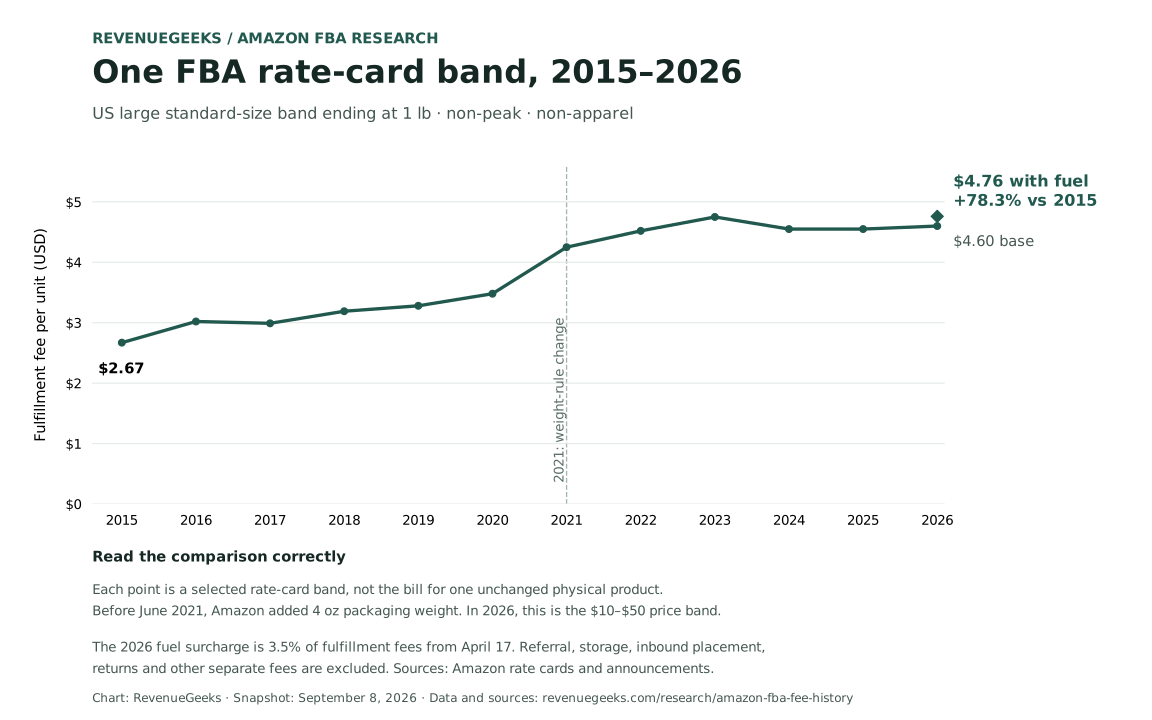
The September 8, 2026 dataset includes the value, units, observation period, source locator and comparison notes. The chart and calculations are by RevenueGeeks, based on Amazon’s rate cards and announcements. You may reuse our chart with a source credit and link to this page. Keep its rate-band and surcharge notes with the image.
To reproduce the headline increase: ($4.76 ÷ $2.67 − 1) × 100 = 78.3%. The base-fee comparison is ($4.60 ÷ $2.67 − 1) × 100 = 72.3%. The 2021 band change means neither percentage can be applied automatically to an individual ASIN.
For a correction, include the affected row and a primary rate-card or announcement link when you contact RevenueGeeks. Dated download files remain available when later snapshots are added.
Frequently Asked Questions
How much have Amazon FBA fees increased since 2015?
The selected large standard-size rate-card band rose from $2.67 in 2015 to $4.60 in 2026, or $4.76 including the fuel surcharge: increases of 72.3% and 78.3%, respectively. Weight rules changed in June 2021, so this is not a like-for-like bill for one physical product.
Does Amazon raise FBA fees every year?
No. The selected reference band fell in 2017 and 2024 and stayed flat in 2025. Other fee types can change even when a particular fulfillment rate falls or stays flat. Amazon announced no increases to referral or FBA fees for 2025.
When do Amazon fee changes take effect?
Effective dates vary by fee and year. For example, the 2021 fulfillment change started June 1, while the 2026 base-card change started January 15 and its fuel surcharge started April 17. Read the relevant announcement rather than assuming one annual date.
What is the 2026 Amazon fuel surcharge?
Amazon introduced a 3.5% fuel and logistics surcharge on US FBA fulfillment fees from April 17, 2026. It applies to the fulfillment fee, not the product sale price. A $4.60 base fee becomes $4.761, or approximately $4.76.
What new Amazon fees exist since 2022?
This page tracks seven selected introductions or expansions: the 2022 fuel surcharge, holiday peak fulfillment, storage utilization, inbound placement, low-inventory, expanded returns processing, and the 2026 fuel surcharge. It is not a count of every fee Amazon charges.
How much is Amazon storage compared to before?
The selected standard-size off-peak storage rate rose from $0.54 per cubic foot per month in 2016 to $0.78 in 2026, about 44%. This excludes aged-inventory and utilization surcharges and does not average rates across each calendar year.
What was the biggest single FBA fee increase?
In this reference series, June 2021 is the largest percentage step: $3.48 to $4.25, or 22.1%. Amazon also removed the packaging-weight adjustment and changed bands, so some individual products could pay less despite the higher reference-band value.
How do FBA fee increases compare to inflation?
The reference fee including fuel rose 78.3%, while CPI-U rose 41.4% from the 2015 annual average to the May 2026 monthly reading. The CPI comparison uses mixed annual and monthly endpoints and the fee series has a 2021 band change.
Will FBA fees go up again next year?
Future increases are unknown until Amazon announces them. A 5% stress case can help with margin planning, but historical averages are not a forecast or a guaranteed increase.